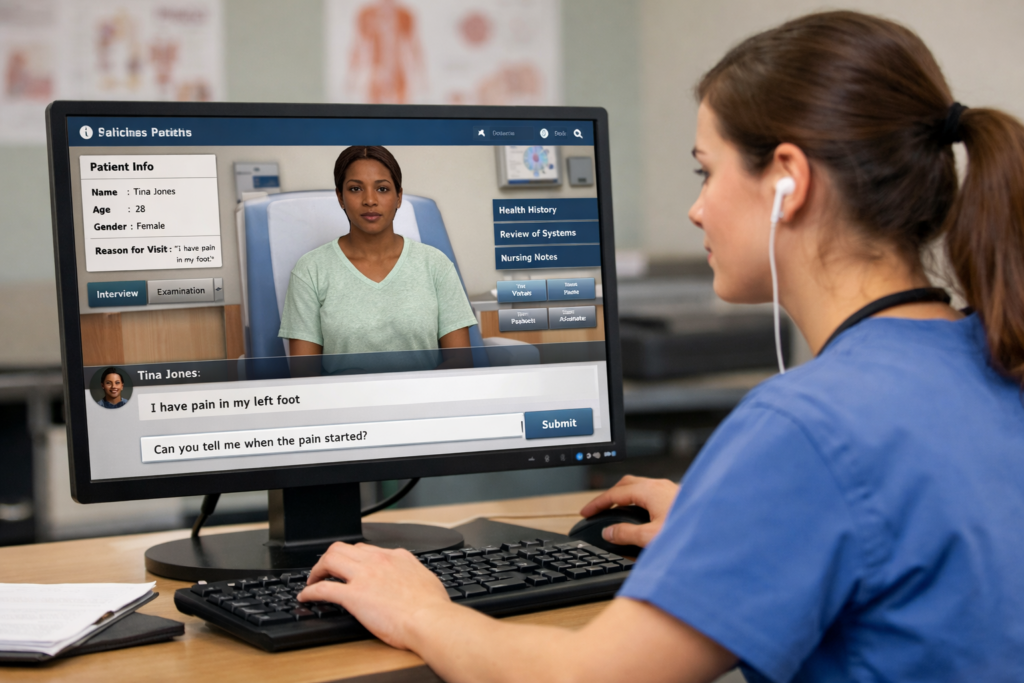
To perform a thorough comprehensive assessment, points noted with regard to Tina’s Shadow Health Simulation test, such as strong communication, will be discussed in this clinical article. The process will involve gathering the health history, doing a head-to-toe assessment, documenting the findings, and coming up with a care plan at the tail end. Preparation, assessment strategies, and key areas to focus on during the simulation are fundamental factors to aid in the success of this simulation.
Shadow Health Preparation for a Comprehensive Assessment.
Review patient chart: Familiarize yourself with the patient’s health history and chief complaint. For instance, it was noted that Tina is a diabetic patient with a childhood diagnosis of asthma. She recently got a foot injury when she was attempting to change a light bulb. Take note of any abnormal vital signs especially if the patient is suffering from diseases such as hypertension, like in Tina Jones’s case.
Key Shadow Health Areas to Focus on During the Assessment.
- Chief Complaint: Always prioritize assessment based on the patient’s primary reason for the visit, like in this case, Tina Jones reported pain on her left foot.
- Pain Assessment: Characterize the patient’s foot pain. For instance, Tina Jones reported a recent foot injury on the left foot that was causing her severe pain. She rated the pain at 7/10 and described it as throbbing and sharp whenever she puts weight on it.
- Musculoskeletal exam: Assess Tina’s foot and ankle. For instance, when Tina was asked if she had any musculoskeletal issues, she denied having complications.
General Shadow Health Tips for Success.
- Prepare Thoroughly: Before starting the comprehensive assessment, make sure you’ve reviewed the patient chart well noting the relevant factors such as health history and chief complaint. Also, practice with a number of simulations in tutorial mode to boost confidence.
- Build Rapport and Communicate Effectively: When communicating with the patient, make sure you use therapeutic language by employing empathy and respectful language. Also, use open-ended questions during the assessment. For instance, “What are the triggers to your asthma?”
- Time management: When conducting the assessment, allocate time wisely for each section. Allocate the most time to the most complex system and the shortest for the least complex. For instance, in comprehensive assessment, it has been noted that the respiratory system takes the shortest time to examine during the physical examination while the neurological and musculoskeletal system takes more time.
- Thorough Documentation: It is always advisable to document your findings as you proceed from one system to another and always ask follow-up questions to avoid confusion during review.
- General Feedback: After finishing the simulation, review the student performance index for scores and note on areas of strengths and those that need improvement and consult with experts for correction.
Common Mistakes to Avoid.
- Incomplete Questioning: Don’t skip on asking follow-up questions. For instance, failing to ask aggravating factors to Tina Jones’s foot pain.
- Poor Documentation: Heavy reliance on auto-suggestions instead of detailed notes leads to incomplete documentation of records, which might in turn cause confusion during review.
- Rushing the Exam: Skipping full system reviews during the assessment might lead to the student nurse missing on certain abnormalities; hence, the process should be conducted carefully without rushing. One key area that a student might easily miss is the presence of reduced proprioception and sensation on Tina Jones’s foot during neurological examination. One needs to be very keen in order to pick this finding.
- Lack of Integration: Failing to connect the data across the systems can prove to be a challenge. For instance, failing to link Tina Jones’s chronic foot wound to complications to uncontrolled diabetes.
Shadow Health Conclusion.
By following the steps discussed above, the nurses’ clinical skills are enhanced, achieving higher proficiency scores and better preparation for real -world nursing practice aided by the comprehensive assessment of Tina Jones during her Shadow Health Simulation.
For more Shadow Health articles visit our website https://taicresearch.com/articles/
References.
Centers for Disease Control and Prevention. (n.d.). CDC. https://www.cdc.gov/
MedlinePlus. (n.d.). MedlinePlus – Health Information from the National Library of Medicine. https://medlineplus.gov/
NANDA International, Inc. (2025, October 14). NANDA International, Inc | Home. NANDA International, Inc |. https://www.nanda.org/ Shadow Health Health Assessment Digital Clinical ExperiencesTM for undergraduate nursing students. (n.d.). www.elsevier.com. https://www.elsevier.com/products/shadow-health/health-assessment